
Evil rarely arrives with a declaration. It does not kick down the door or announce its intentions. It arrives quietly — in a compromise that seems small, an alliance that seems necessary, a silence that seems harmless. It settles into the spaces where power lives and waits, patient and watchful, for the moment when no one is paying close enough attention.
Sharon Storts Yahres knows this. And in The Presence of Evil, she has written a novel that takes that knowledge seriously — one that asks not just how evil acts, but how it hides, and what it costs good people to see it clearly before it is too late.
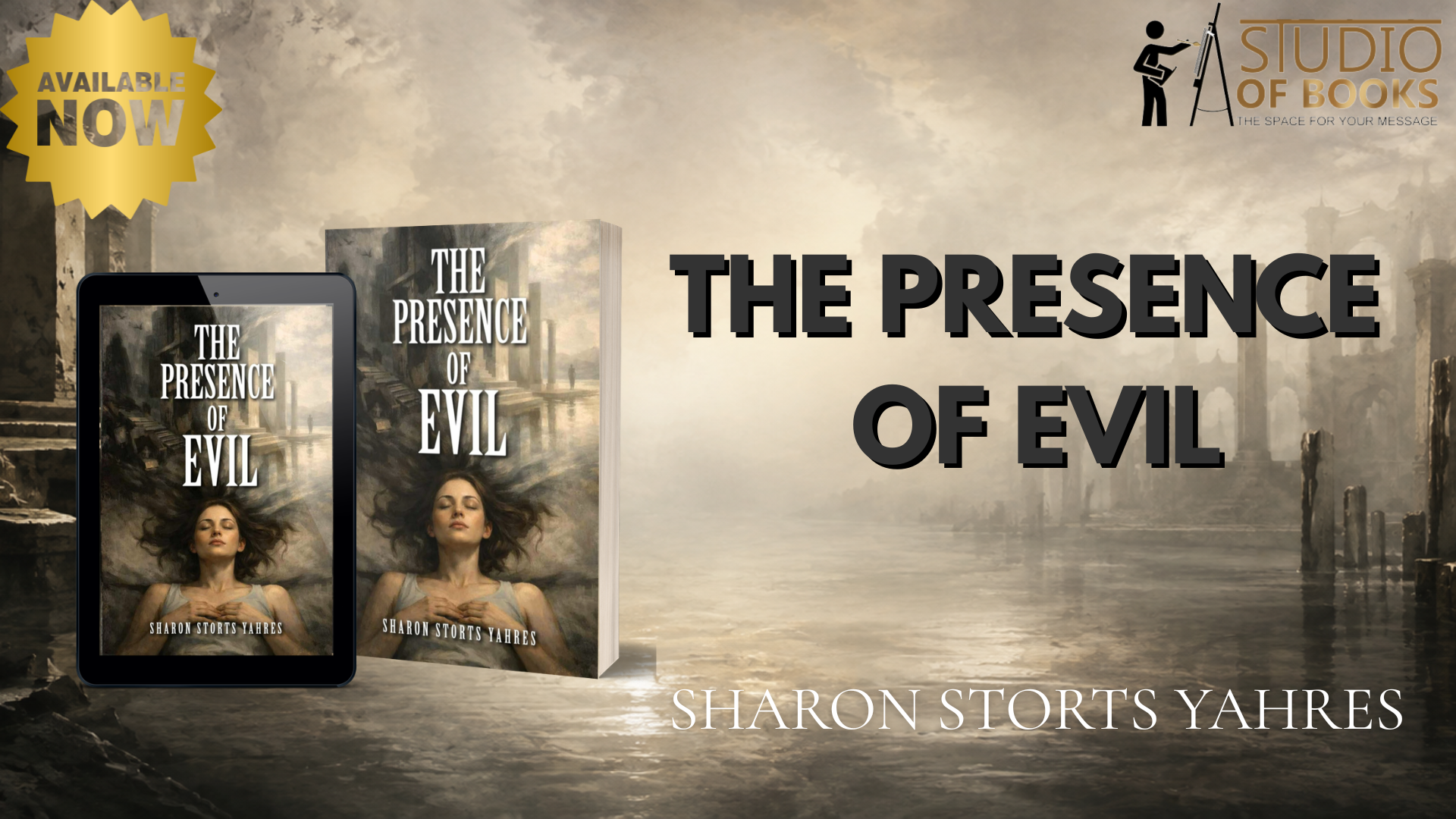
Studio of Books is proud to announce the release of this thought-provoking, quietly gripping work of political and spiritual fiction — a novel unlike anything else on the shelf right now.
Dr. Richard Years spent his career at the highest levels of American power. As a White House physician, he moved through corridors where the stakes were never abstract — where the decisions made behind closed doors shaped the lives of millions. He has seen things. He knows things. And when his quiet retirement in Virginia is shattered by a summons he cannot ignore, he finds himself pulled back into a world he believed he had finally left behind.
What follows is not the kind of thriller that trades in car chases and convenient revelations. The Presence of Evil moves differently — with the deliberate, unsettling patience of a story that understands evil on its own terms. The meetings are secret but mundane. The alliances are uneasy but explicable. The compromises are small enough, at first, to seem like wisdom rather than surrender. Yahres builds her tension not through spectacle but through atmosphere — through the accumulating weight of questions that won’t resolve and answers that cost more than anyone wants to pay.
At the heart of the novel are three people navigating this darkness from very different angles. Dr. Years himself — aging, grieving, and burdened by a haunting awareness of what he has witnessed and what he has perhaps allowed — carries the moral gravity of the story. His daughters, Princess and Duchess, drawn into the mystery by a family summons that reveals far more than they were prepared for, bring urgency, perspective, and the particular clarity that comes from seeing a parent’s world with fresh eyes.
Together, they move through a Washington, D.C. that Yahres renders with sharp, knowing detail — not as a backdrop of monuments and ceremonies, but as a living environment of influence and concealment, where what is said in public and what is decided in private are rarely the same thing.
Their journey is not just a political one. It is a spiritual reckoning. A confrontation with conscience. A test of what it means to remain a good person inside systems that reward looking the other way.
What makes The Presence of Evil so distinctive — and so resonant — is the way it refuses to reduce its central question to a simple one. Yahres is not interested in cartoonish villainy or easy moral victories. She is interested in the harder, more honest territory: how darkness manifests through silence rather than just action, through unchecked ambition rather than just malice, through the slow erosion of conscience that happens when good people decide, again and again, that now is not the right moment to speak.
Set against the backdrop of American governance at its most complex and conflicted, the novel asks something that feels urgently, uncomfortably relevant: how do we recognize evil when it wears the same face as power, pragmatism, and political necessity?
There is no simple answer. But the asking of it, with the seriousness and the care that Yahres brings, is itself an act of courage.
For readers who love political fiction with genuine moral depth, The Presence of Evil will feel like essential reading. For those drawn to stories that take faith and spiritual reckoning seriously within a secular, high-stakes setting, it offers something rare — a novel that holds those dimensions together without sacrificing the tension of either. And for anyone who has ever wondered how the people closest to power navigate the distance between what they know and what they are able to say, this novel provides a window that is as uncomfortable as it is illuminating.
Sharon Storts Yahres writes with the careful, considered hand of a storyteller who has thought deeply about the questions her novel raises — and who trusts her readers to sit with them rather than rush toward resolution. The Presence of Evil is character-driven in the truest sense: a novel whose suspense lives not in plot mechanics but in the interior lives of people under pressure, making choices that matter, in a world that would prefer they didn’t look too closely. It is a remarkable and timely debut into political and spiritual fiction.