
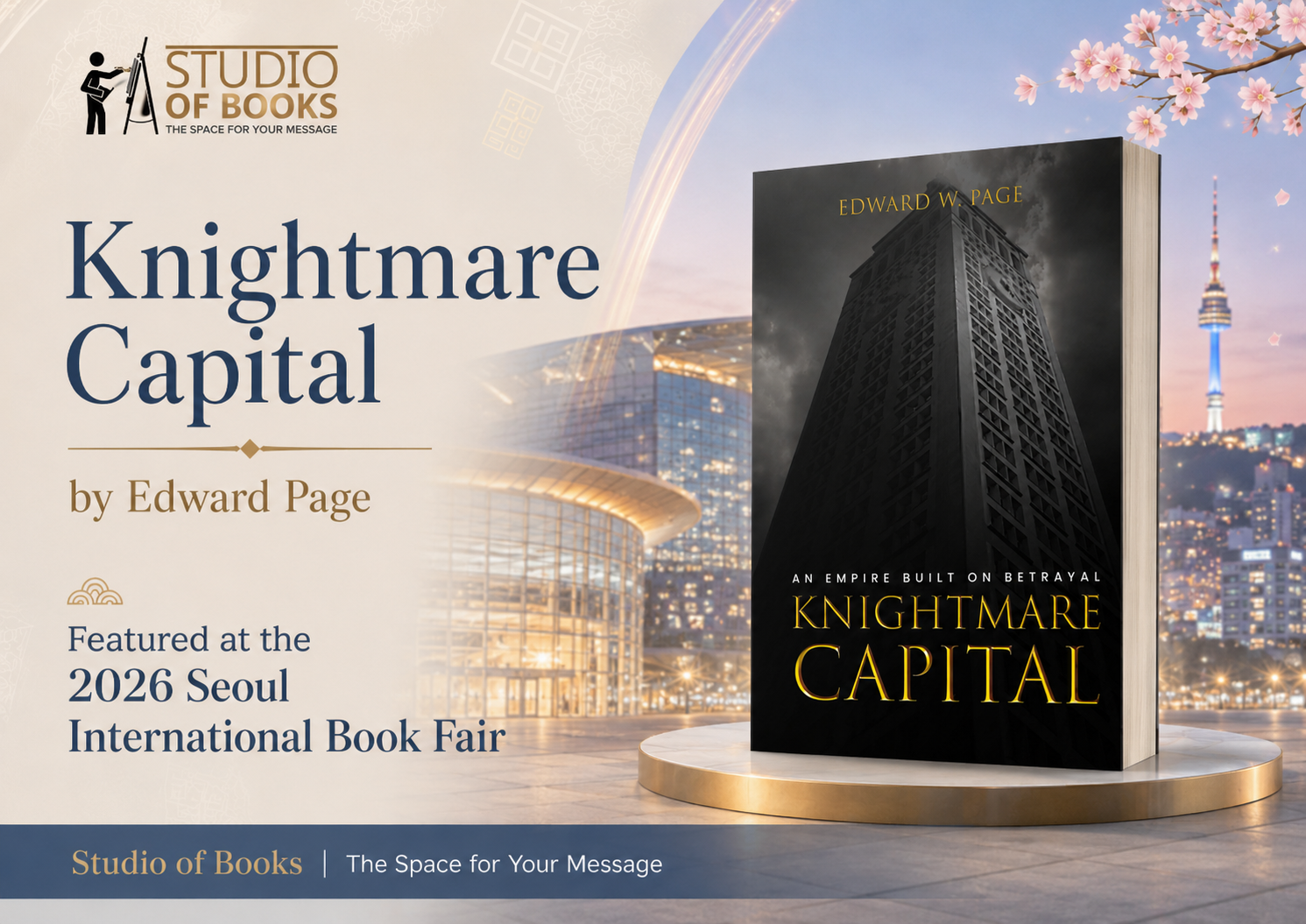

Studio of Books proudly featured Knightmare Capital by Edward Page at the 2026 Seoul International Book Fair, held from June 24–28, 2026, at COEX Mall in Seoul, South Korea.
Among the many titles presented during one of Asia’s most dynamic literary gatherings, Knightmare Capital brought a sharp, candid, and experience-driven business narrative to the Studio of Books showcase. Edward Page’s memoir takes readers inside the demanding world of private equity, where ambition, judgment, discipline, and accountability can determine whether companies are saved, strengthened, or pushed toward collapse.
The book follows Page’s professional journey from surety bond underwriting and commercial banking into the volatile and high-pressure arena of private equity. After beginning his career in New Jersey and Missouri, he moved into the world of acquisitions, financing, management, and divestitures, commuting from St. Louis to Manhattan as he became deeply involved in complex business deals across North America and Europe.
This is what gives Knightmare Capital its authority. It is not written from a distance. It is shaped by lived experience in rooms where decisions carried real consequences. Page writes from the perspective of someone who has seen the thrill of opportunity, the difficulty of negotiation, the complexity of corporate turnarounds, and the danger that emerges when leadership loses discipline.
At the 2026 Seoul International Book Fair, this kind of story found a strong international stage. SIBF brought together readers, authors, publishers, entrepreneurs, professionals, and literary voices from different fields and cultures. Within that environment, Knightmare Capital stood out as a business memoir with both practical insight and human weight. It offered readers a look beyond polished success stories and into the demanding reality of deals, pressure, risk, and responsibility.
Seoul provided a fitting backdrop for the book’s showcase. Known for its innovation, modern business energy, global outlook, and fast-moving professional culture, the city reflected many of the tensions found in Page’s account. Against the atmosphere of COEX and the international spirit of the fair, Knightmare Capital invited readers to consider what leadership really means when capital, companies, careers, and livelihoods are on the line.
One of the strongest aspects of the book is its refusal to treat business as numbers alone. Private equity can easily be discussed through transactions, strategy, returns, and valuations. Page’s memoir reminds readers that behind every acquisition and turnaround are people, families, employees, owners, and communities affected by the choices made at the top. When leadership is disciplined and responsible, companies can be preserved and jobs can be saved. When leadership becomes careless, unstable, or driven by ego, the damage can spread quickly.
That human dimension gives the book its lasting impact. Knightmare Capital is not only about the excitement of deal-making. It is also about what happens when momentum hides weakness, when ambition outruns accountability, and when an organization’s future depends on leaders who may or may not be worthy of the trust placed in them.
Page’s story also carries the tension of professional transformation. He entered a world that promised opportunity and momentum, shaped by red-eye flights, late-night negotiations, boardroom pressure, and lessons from sharp minds in accounting, finance, law, engineering, and operations. That world sharpened his judgment and expanded his understanding of what it takes to acquire, manage, repair, and exit companies in difficult circumstances.
But the same world also revealed how quickly things can unravel. As the book shows, business success can be fragile when the foundation beneath it is compromised. Mismanagement, instability, power struggles, and erratic leadership can turn opportunity into crisis. What begins as a promising professional climb can become a warning about the cost of neglecting discipline, ethics, and clear decision-making.
This makes Knightmare Capital especially meaningful for entrepreneurs, executives, investors, business students, advisors, and readers interested in leadership under pressure. It offers insight into the mechanics of business, but it also asks a deeper question: what kind of person should hold power when the consequences affect more than balance sheets?
The book’s relevance extends beyond private equity. Its lessons apply to anyone interested in organizations, decision-making, accountability, and the human responsibility of leadership. Whether in finance, entrepreneurship, management, or public life, leaders are often judged not only by what they build, but by what survives because of their choices.
Studio of Books was honored to feature Knightmare Capital by Edward Page as part of its 2026 Seoul International Book Fair showcase. The title joined a curated selection of works representing meaningful voices, professional insight, and author-driven messages. Page’s memoir brought a compelling business perspective to the collection, reflecting the importance of books that reveal the realities behind ambition, pressure, and professional success.
Guided by its tagline, “The Space for Your Message,” Studio of Books continues to support authors by helping their works reach meaningful literary platforms. For Knightmare Capital, the Seoul International Book Fair offered a valuable opportunity to share its business insight and cautionary message with a broader international audience.
Although the 2026 Seoul International Book Fair has concluded, the message of Knightmare Capital continues to resonate. Edward Page’s memoir remains a compelling read for those interested in private equity, corporate turnarounds, entrepreneurship, finance, leadership, and the real-world consequences of high-stakes decisions.
Through its showcase in Seoul, the book became part of an international celebration of literature, knowledge, and professional experience. Its presence at SIBF 2026 gave the work another meaningful space to be seen, considered, and remembered.
At its heart, Knightmare Capital is a reminder that ambition may open doors, but integrity, discipline, judgment, and accountability determine what survives when the pressure rises.